

2026-10-22
Selecting a manufacturing partner for interconnect solutions involves more than comparing unit prices. In complex ecosystems like automotive diagnostics, industrial automation, or medical electronics, the integrity of a wiring harness determines the reliability of the entire system. Signal degradation, electromagnetic interference (EMI), and mechanical fatigue are constant threats that only rigorous engineering and precise material selection can mitigate.
When sourcing a SOAR custom cable assembly and wiring harness, engineers and procurement managers must look beyond basic connectivity. The goal is to achieve a balance between electrical performance, environmental resilience, and manufacturing scalability. Whether it is an OBDII diagnostic cable for heavy-duty trucks or a multi-conductor harness for robotic arms, the quality of the assembly lies in the details of the termination, shielding, and jacketing.
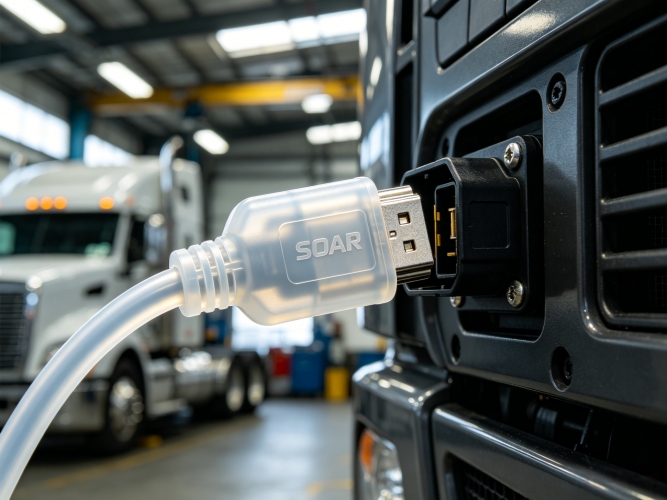
The first step in any high-quality custom harness project is matching the material profile to the operating environment. A cable used in a climate-controlled data center faces different stressors than one utilized in an automotive engine bay or a construction site.
Common Insulation and Jacketing Materials:
Beyond the jacket, internal components like fillers (to maintain roundness) and shielding (AL-Mylar foil vs. tinned copper braiding) must be specified based on the required EMI/RFI protection levels. In automotive diagnostic cables, for instance, high-coverage braiding is essential to prevent engine noise from corrupting data transmission during vehicle ECU remapping.
A wiring harness is a complex nervous system. For an OEM project to succeed, the assembly must adhere to strict IPC-A-620 standards (Requirements and Acceptance for Cable and Wire Harness Assemblies). This standard governs everything from the height of a terminal crimp to the positioning of a heat-shrink tube.
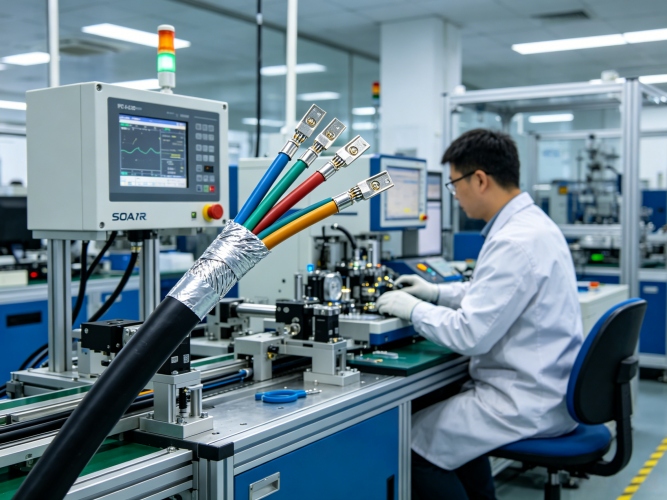
The mechanical bond between the wire and the terminal is the most frequent point of failure. Over-crimping can crush the copper strands, increasing resistance and leading to heat buildup. Under-crimping results in high contact resistance and potential pull-out. Quality manufacturers utilize automated crimp force monitoring (CFM) to ensure every single termination meets the specified pull-force requirements.
For automotive applications, connectors must often meet IP67 or IP68 ratings for water and dust ingress. SOAR’s expertise in automotive diagnostic cables involves integrating specialized OBDII, J1939, or M12 connectors that can withstand thousands of mating cycles without pin deformation.
Overmolding involves injecting molten plastic (typically PVC or TPU) around the connector/cable junction. This provides superior strain relief and seals the internal connections from moisture. For low-volume prototypes or heavy-duty industrial repairs, mechanical backshells may be used, though overmolding remains the gold standard for high-durability OEM production.
When evaluating a SOAR custom cable assembly and wiring harness, it is helpful to understand how customization impacts long-term performance compared to "off-the-shelf" alternatives.
| Feature | Off-the-Shelf Cables | SOAR Custom Solutions |
|---|---|---|
| Signal Integrity | Standard shielding; prone to EMI in industrial settings. | Optimized shielding (Braiding + Foil) for specific frequencies. |
| Durability | Generic PVC jackets; limited flex life. | Application-specific materials (PUR/TPU) for high-flex or oil resistance. |
| Fitment | Fixed lengths; often requires "coiling" excess wire. | Precise lengths and branch points to minimize space and weight. |
| Compliance | General CE/RoHS. | Industry-specific (UL, IPC Class 3, REACH, TS16949). |
| Connectivity | Standard USB/DB9/OBDII. | Custom pinouts, proprietary connectors, and integrated PCBA. |
In the automotive diagnostic sector, the move toward CAN FD (Flexible Data-rate) and Ethernet-based diagnostics (DoIP) has changed the requirements for wiring harnesses. High-speed data transmission requires controlled impedance and twisted-pair geometry that must remain consistent even through tight bends in the harness.
When designing a SOAR custom cable assembly and wiring harness for vehicle diagnostics, engineers focus on:
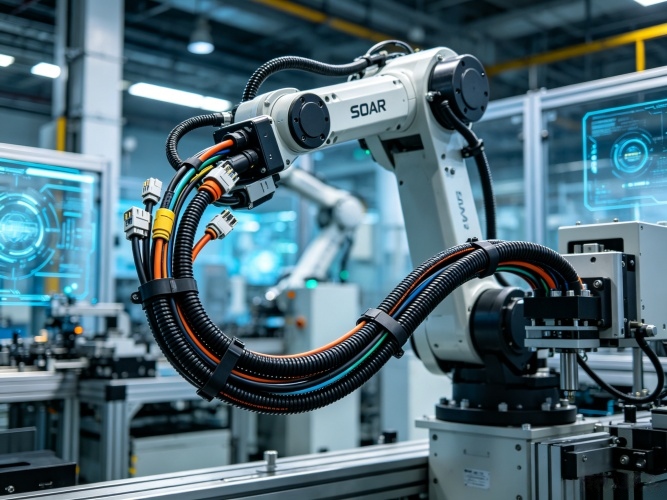
A reliable B2B procurement process for custom interconnects follows a structured engineering path. This ensures that the final product matches the digital schematic and the physical environment.
For OEM project managers, the choice of a harness supplier is a choice of a long-term technical partner. Evaluating a provider's capability involves looking at their testing lab, their mastery of overmolding technology, and their ability to source authentic components (Molex, TE Connectivity, JST) rather than low-quality clones.
SOAR’s focus on the automotive and industrial sectors allows for a deep understanding of the ruggedization required for professional-grade tools. By integrating high-grade TPU jacketing with precision-crimped OBDII connectors, the resulting SOAR custom cable assembly and wiring harness offers the durability required for workshop environments where cables are stepped on, crushed by toolboxes, or exposed to chemical solvents.
Q: What is the typical MOQ for a custom wiring harness?
A: Minimum Order Quantities (MOQ) vary significantly based on the complexity and the components used. For standard automotive diagnostic cables using readily available connectors, MOQs may start at 100–500 units. For highly specialized harnesses requiring custom injection molds, the MOQ may be higher to offset tooling costs.
Q: Can SOAR assist with the pinout design if we only have a schematic?
A: Yes. A professional manufacturer provides engineering support to translate a circuit schematic into a physical wiring diagram, including wire color-coding, gauge selection, and sleeve labeling for easy installation.
Q: How does shielding affect the flexibility of the cable?
A: Generally, a foil shield is less flexible and can crack under repeated bending. A braided shield (using fine tinned copper wire) is more flexible and provides better mechanical strength, though it increases the cable's outer diameter and weight.
Q: What certifications should I look for in a cable manufacturer?
A: For international B2B trade, ensure the manufacturer is ISO 9001 certified for quality management. For specific industries, look for IATF 16949 (Automotive), ISO 13485 (Medical), or UL-listed wiring components for safety compliance in the North American market.


