Compare FAKRA vs SMA connectors. Learn about mechanical locking, frequency ranges, and automotive vs. industrial applications to select the right RF interface.
Selecting the right RF connector is a critical decision in wireless system design, influencing everything from signal integrity to assembly speed on the production line. While both FAKRA and SMA connectors are ubiquitous in RF environments, they serve fundamentally different mechanical and environmental requirements.
Choosing between them is not merely a matter of electrical performance; it is a choice between the high-precision, threaded security of the SMA and the high-speed, vibration-resistant locking mechanism of the FAKRA. For engineers and OEM project managers, understanding these nuances is the difference between a reliable field deployment and a costly signal failure.
What Defines the FAKRA and SMA Standard?
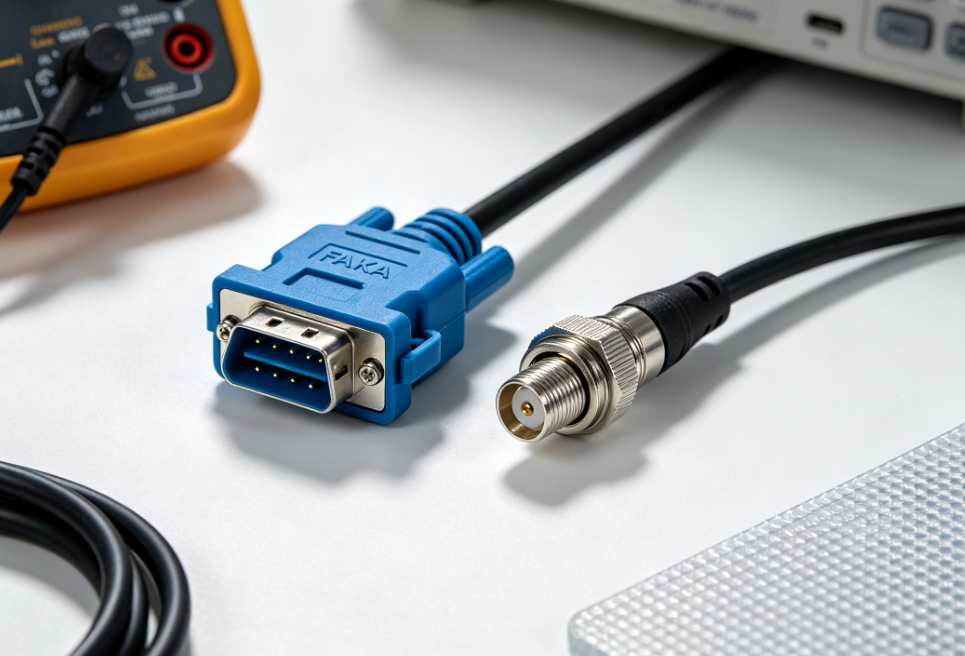
To understand the comparison, we must first look at their origins. The SMA (Sub-Miniature version A) connector is a legacy standard developed in the 1960s. It relies on a threaded coupling mechanism and is designed for semi-rigid and flexible coaxial cables. It is the "workhorse" of the RF world, found in everything from Wi-Fi routers to laboratory grade test equipment.
The FAKRA (Fachkreis Automobil) connector is essentially a modified SMB (Sub-Miniature version B) connector housed within a specialized plastic shell. Developed by the German automotive industry, FAKRA was designed specifically to meet the rigorous demands of vehicular environments—vibration, temperature swings, and the need for rapid, error-proof assembly.
Mechanical Design: Threaded vs. Snap-On Locking
The most visible difference between these two connectors lies in how they mate.
SMA Connector Mechanics:
SMA connectors use a 1/4-inch, 36-thread-per-inch screw mechanism. This requires a specific torque (typically 7–10 inch-pounds for stainless steel) to ensure a secure connection. While this provides excellent electrical stability and shielding, it is time-consuming to install in high-volume manufacturing and is prone to loosening under constant vibration if not properly torqued or secured with thread-locking compounds.
FAKRA Connector Mechanics:
FAKRA connectors utilize a "push-on" and "snap-on" locking system. The outer plastic housing features a primary locking latch that provides an audible "click" when fully engaged. This allows for one-handed installation in seconds. Furthermore, FAKRA connectors often include a secondary locking feature to prevent accidental disconnection, making them far superior for high-vibration environments like engine compartments or industrial machinery.
Frequency Range and Electrical Performance
From a purely electrical standpoint, the SMA generally offers higher performance limits, though FAKRA is catching up in specialized iterations.
| Impedance |
50 Ohm |
50 Ohm |
| Max Frequency |
Up to 18 GHz (Precision up to 26.5 GHz) |
Typically up to 6 GHz |
| Coupling |
Threaded Nut |
Plastic Locking Housing |
| Durability |
500 Mating Cycles |
100 Mating Cycles |
| Vibration Resistance |
Moderate (Requires Torque) |
High (Designed for Automotive) |
SMA connectors are preferred for high-bandwidth applications where signal loss (insertion loss) must be minimized at frequencies above 6 GHz. In contrast, FAKRA is optimized for the DC to 6 GHz range, which covers the majority of modern telematics, GPS, cellular (4G/5G Sub-6), and V2X (Vehicle-to-Everything) communications.
The Role of Color Coding and Keying
One of the greatest challenges in complex RF integration is "mis-mating"—plugging the wrong antenna into the wrong port.
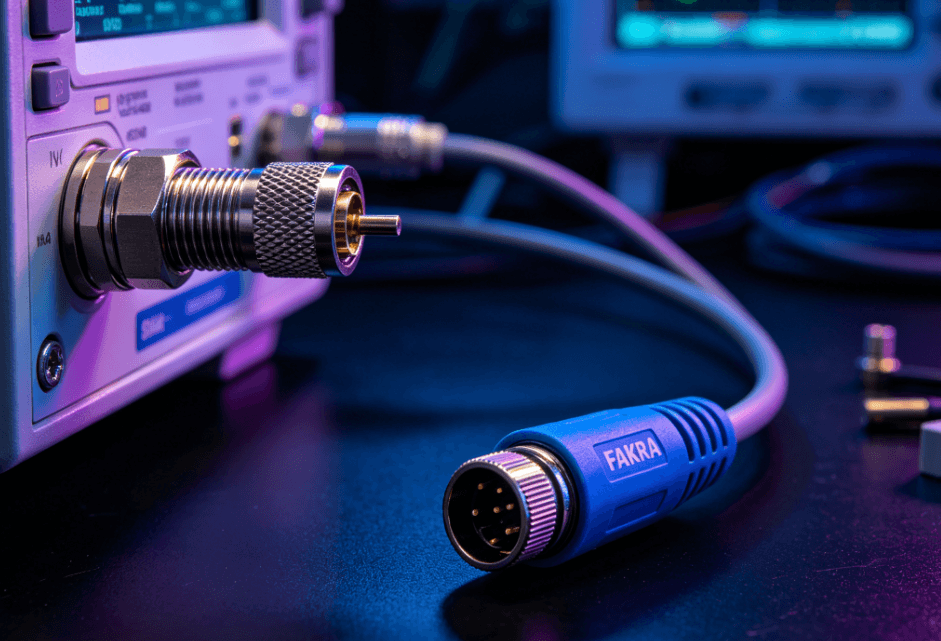
The FAKRA standard solves this through mechanical keying and color coding. There are approximately 14 different FAKRA "codes" (A, B, C, etc.), each assigned a specific color and a unique set of plastic ribs. For example:
-
Code C (Blue): Typically used for GPS/Navigation.
-
Code D (Bordeaux Violet): Typically used for GSM/Cellular.
-
Code I (Beige): Typically used for Bluetooth/Wi-Fi.
This system ensures that a technician cannot physically plug a GPS antenna into a Wi-Fi port. SMA connectors do not have this built-in safety mechanism; they are universal. In a manufacturing environment where dozens of RF lines converge, the FAKRA system drastically reduces human error and rework costs.
Application Logic: Where to Deploy Each
The choice between FAKRA and SMA is usually dictated by the operating environment and the lifecycle of the product.
1. Automotive and Telematics
If your project involves a vehicle, FAKRA is the industry standard. It meets USCAR-17 and ISO 20860-1 standards. Its ability to withstand extreme thermal cycling (-40°C to +105°C) and mechanical shock makes it the only viable choice for ADAS (Advanced Driver Assistance Systems), infotainment, and autonomous driving sensors.
2. Industrial IoT and Antennas
For stationary industrial IoT gateways or indoor wireless routers, SMA is often more cost-effective. Since these devices are rarely moved once installed, the threaded connection provides a stable, long-term interface. Many standard RF connector assemblies utilize SMA for its compatibility with a wide range of off-the-shelf antennas.
3. Test and Measurement
In laboratory settings, SMA is king. The precision of the threaded interface allows for repeatable measurements and minimal VSWR (Voltage Standing Wave Ratio). FAKRA is rarely used in test equipment unless specifically testing automotive components.
Manufacturing and Assembly Considerations
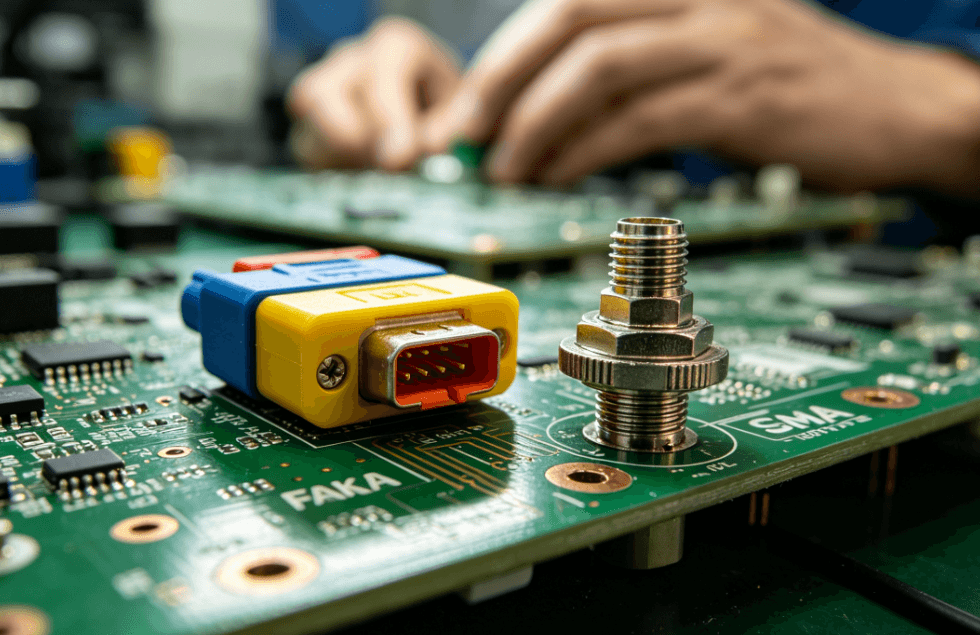
From an OEM perspective, the FAKRA connector's footprint is larger than a standard SMA due to the plastic housing. When designing a PCB (Printed Circuit Board), engineers must account for this increased real estate.
However, FAKRA offers significant advantages in cabling and harness assembly. FAKRA connectors are designed for automated high-speed stripping and crimping processes. When dealing with high-volume production, the labor savings of a snap-on FAKRA vs. a threaded SMA can be substantial.
At Soarcable, we often see engineers moving toward specialized hybrid solutions—using SMA for internal module testing and transitioning to FAKRA for the external-facing user interface to ensure field durability.
Summary of Differences
-
Security: SMA uses threads; FAKRA uses a plastic latch.
-
Frequency: SMA reaches 18GHz+; FAKRA is optimized for sub-6GHz.
-
Speed: FAKRA is significantly faster to install in assembly line environments.
-
Error-Proofing: FAKRA’s color-coding prevents incorrect connections; SMA is universal.
-
Environment: FAKRA is built for vibration and harsh automotive cycles; SMA is built for stability and precision.
FAQ
Can I mate a FAKRA connector to an SMA connector?
No, they are not directly compatible. However, you can use a FAKRA-to-SMA adapter or pigtail cable. Internally, a FAKRA connector uses an SMB-style interface, but the outer housing prevents any direct connection to an SMA thread.
Are FAKRA connectors waterproof?
Standard FAKRA connectors are not inherently waterproof. However, there are "Waterproof FAKRA" variants (often rated IP67 or IP69K) that include specialized O-rings and seals for use in external automotive applications like shark-fin antennas or cameras.
Why is SMA more common in Wi-Fi routers than FAKRA?
Wi-Fi routers are consumer electronics used in static environments. The SMA connector is smaller, cheaper to manufacture without the complex plastic housing, and allows consumers to easily screw on aftermarket antennas without needing specialized keyed connectors.
What is "High-Speed FAKRA" (FAKRA-Mini)?
As automotive data needs increase (for 4K cameras and LIDAR), the industry is moving toward "Mini-FAKRA" (also known as HFM). These are much smaller than standard FAKRA and support data rates up to 20 Gbps and frequencies up to 15 GHz, bridging the performance gap between traditional FAKRA and SMA.
Reference Sources
-
ISO 20860-1: Road vehicles — 50 ohm radio frequency interface — Part 1: Dimensions and electrical requirements.
-
USCAR-17: Performance Specification for Automotive RF Connector Systems.
-
IEC 60169-15: Radio-frequency connectors - Part 15: R.F. coaxial connectors with inner diameter of outer conductor 4.13 mm (0.163 in) with screw coupling - Characteristic impedance 50 ohms (Type SMA).
-
IEEE Xplore: Comparative analysis of RF connector signal integrity in high-vibration environments.


