Discover how SOAR supports automotive OEMs with high-precision custom wiring harness manufacturing. From EV architecture to ADAS, explore our engineering-first approach to signal integrity and durability.
The transition from mechanical-heavy vehicles to software-defined machines has fundamentally altered the requirements of the electrical backbone. Modern vehicles are no longer simple circuits; they are mobile data centers requiring high-speed communication, robust power distribution, and extreme environmental resilience. As a dedicated SOAR Custom Auto Wiring Harness Manufacturer, the focus shifts from merely "supplying parts" to becoming an integrated engineering partner.
For OEM project managers and automotive engineers, the challenge lies in balancing space constraints with the increasing complexity of sensors, infotainment, and powertrain management. A custom harness is the solution to these spatial and functional bottlenecks, ensuring that every millimeter of the chassis is optimized for performance and safety.
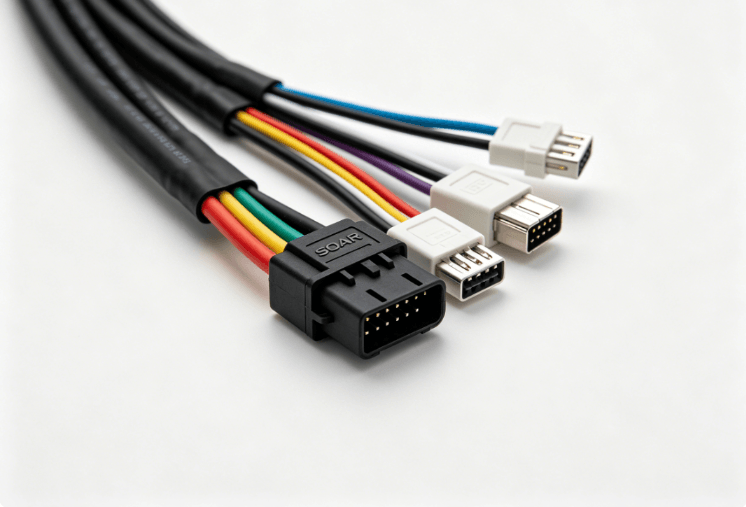
Material Science: The Foundation of Harness Reliability
Automotive environments are among the most hostile for electrical components. Constant vibration, thermal cycling (ranging from -40°C to +125°C or higher), and exposure to corrosive fluids necessitate a rigorous approach to material selection.
At the core of a SOAR custom solution is a deep understanding of conductor and insulation properties:
- Conductor Selection: We utilize high-purity oxygen-free copper to minimize resistance and heat buildup, particularly in high-voltage EV applications.
- Advanced Insulation: Depending on the application, we deploy XLPE (Cross-linked Polyethylene) for superior heat resistance or specialized PVC for cost-effective, flexible routing in non-critical zones.
- EMI/RFI Shielding: With the rise of ADAS (Advanced Driver Assistance Systems), protecting low-voltage signals from electromagnetic interference is critical. We integrate braided shielding and foil wraps to ensure signal purity across the CAN bus and Ethernet lines.
Navigating the Custom Manufacturing Workflow
Choosing a SOAR Custom Auto Wiring Harness Manufacturer involves more than a transaction; it is a multi-stage technical journey. Our workflow is designed to mitigate risk at the prototyping phase before scaling to mass production.
- DFM (Design for Manufacturing) Analysis:
Our engineers review your CAD models to identify potential failure points, such as tight bend radii or improper strain relief. We suggest optimizations that reduce assembly time on your production line.
- Prototyping and Rapid Iteration:
Before committing to expensive tooling, we provide functional prototypes. This allows for real-world fitment testing within the vehicle frame, ensuring that connector orientations and branch lengths are precise.
- Tooling and Component Sourcing:
We leverage a global supply chain to source automotive-grade connectors (e.g., TE Connectivity, Molex, Yazaki) or develop custom molds if a standard solution does not exist.
- Automated Processing:
To maintain the tight tolerances required by automotive standards, we utilize automated wire stripping, crimping, and ultrasonic welding. This minimizes human error and ensures consistency across thousands of units.
Meeting Stringent Industry Standards and Compliance
The automotive sector is governed by non-negotiable safety standards. As a leading manufacturer, SOAR aligns its production processes with global benchmarks to ensure every harness is road-ready.
- IATF 16949 Compliance: Our quality management systems are geared toward continuous improvement and defect prevention, a prerequisite for Tier 1 and Tier 2 suppliers.
- IPC/WHMA-A-620 Standards: We adhere to the highest class of cable and wire harness assembly requirements, ensuring every crimp and solder joint meets rigorous pull-force and conductivity benchmarks.
- Environmental Sealing: For exterior or engine bay applications, we utilize over-molding and heat-shrink technologies to achieve IP67 or IP69K ratings, protecting against high-pressure washdowns and submersion.
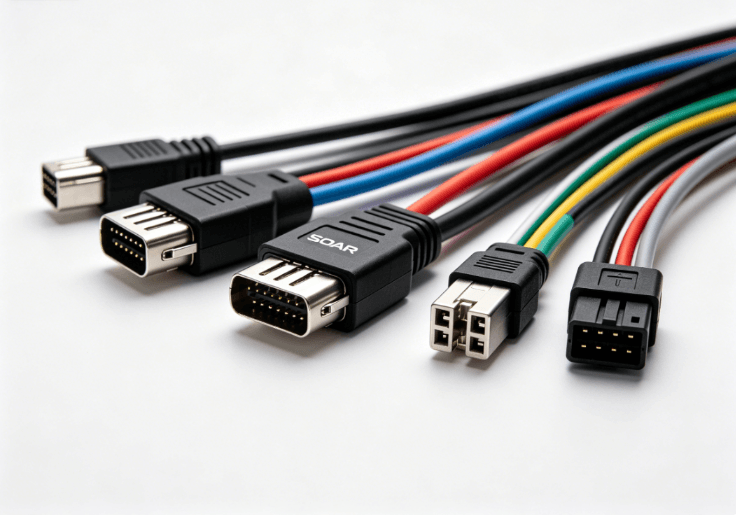
Application-Specific Engineering: From ICE to EV
The requirements for a wiring harness vary drastically depending on the vehicle's powertrain and utility.
Internal Combustion Engines (ICE)
The priority is thermal management and vibration resistance. Harnesses routed near the exhaust manifold or engine block require high-temperature sleeving (such as fiberglass or corrugated tubing) to prevent insulation breakdown.
New Energy Vehicles (EV)
EVs introduce the challenge of high-voltage (HV) safety. We design HV harnesses with orange-coded cabling for easy identification, incorporating specialized connectors with HVIL (High Voltage Interlock Loop) to protect technicians and occupants during maintenance or in the event of a collision.
Autonomous and Connected Systems
Data integrity is paramount here. We utilize high-speed data cables (HSD) and FAKRA connectors to support high-resolution camera feeds and LiDAR sensors, ensuring zero-latency communication between the vehicle's "brain" and its sensors.
Why OEM Engineers Choose SOAR as a Strategic Partner
Selecting a harness manufacturer is a decision based on trust and technical transparency. SOAR Custom Auto Wiring Harness Manufacturer distinguishes itself through:
- Vertical Integration: By managing the process from wire extrusion to final assembly, we maintain total control over the quality of the raw materials.
- Testing Rigor: Every harness undergoes 100% continuity testing. For critical systems, we perform automated vision inspections of crimp heights and push-back tests on terminals.
- Scalability: Our facilities are optimized for both high-mix, low-volume (specialized vehicles) and high-volume mass production, allowing us to grow alongside your project.
Through our Automotive Wire Harness collection, we provide a transparent look at our specialized capabilities, allowing engineers to benchmark our technical specifications against their project requirements.
FAQ
Q1: What are the typical lead times for a custom automotive harness prototype?
For standard automotive-grade components, initial prototypes can typically be delivered within 2–4 weeks. Lead times may vary if custom connectors or specialized long-lead components are required by the design.
Q2: How does SOAR ensure durability against extreme vehicle vibrations?
We implement several mechanical safeguards, including anti-vibration tape, corrugated protective looms, and specialized strain relief at the connector interface. Our testing protocols can include vibration table simulation to mirror "worst-case" road conditions.
Q3: Can SOAR provide full PPAP (Production Part Approval Process) documentation?
Yes. We support the standard PPAP levels required by automotive OEMs to ensure that the manufacturing process is capable of consistently producing parts that meet all requirements.
Q4: What wire gauges (AWG) can you accommodate in your manufacturing facility?
We process a wide range of wire gauges, from fine-gauge signal wires (28 AWG) for sensors to heavy-duty power cables (4/0 AWG and beyond) for battery and motor connections in electric vehicles.
Q5: How is signal interference managed in complex infotainment harnesses?
We use a combination of twisted-pair wiring, targeted shielding (braid or foil), and specific grounding strategies. We can also integrate ferrite cores into the harness design to suppress high-frequency noise.
Reference Sources
- ISO 6722-1: Road vehicles — 60 V and 600 V single-core cables — Dimensions, test methods and requirements. ISO Official Site
- SAE J1128: Low Voltage Primary Cable standard for automotive electrical systems. SAE International
- IPC/WHMA-A-620: Requirements and Acceptance for Cable and Wire Harness Assemblies. IPC Standards
- IATF 16949: International Standard for Automotive Quality Management Systems. IATF Global Oversight


